

#Technology
Ecosystem technology, end to end
Layered architecture, communications and protocols, security and firmware: how the AITHA ecosystem works and how it integrates with your systems.
The ecosystem layers
AITHA covers the full path of a data point: from the field measurement to the decision in your systems.
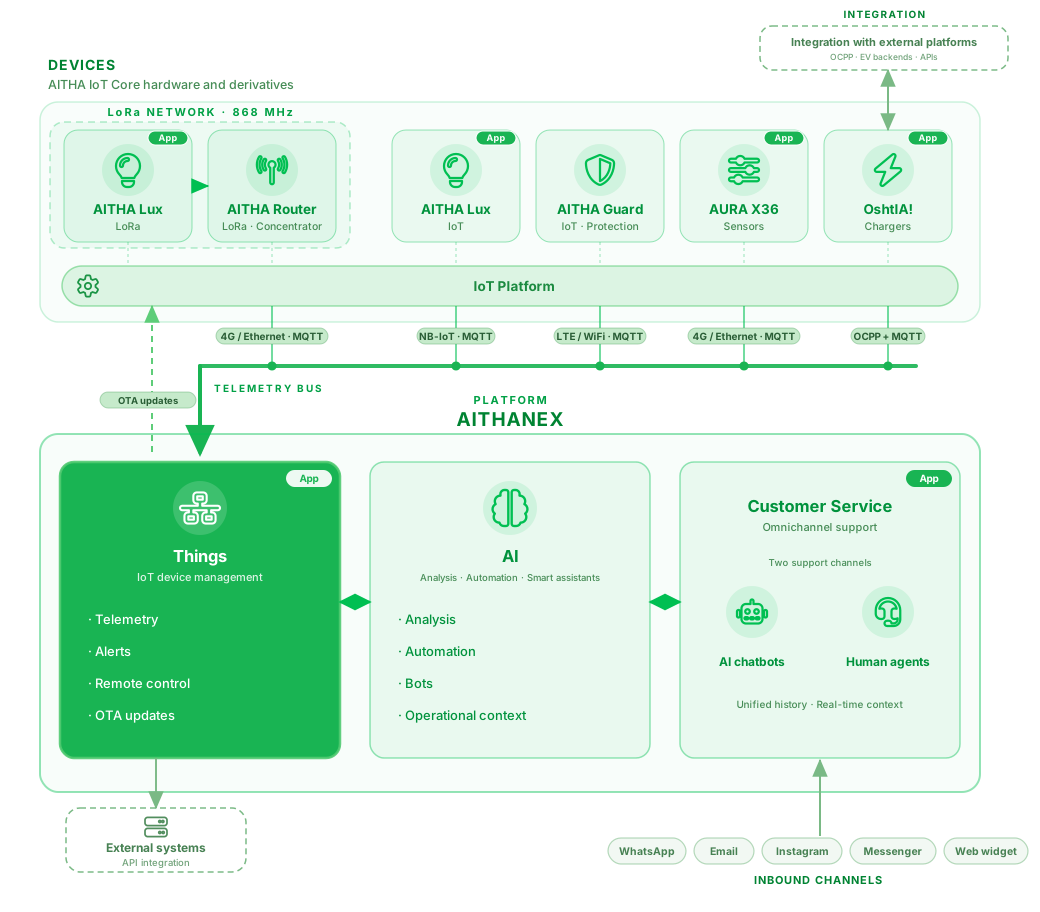
The data journey
From sensor to action, in one diagram.
Communications and protocols
Each device reports to the platform through its medium: 4G/Ethernet, NB-IoT, LTE/WiFi or EV charging, always over MQTT.
Compatibility at a glance
Standards available by product; per-device detail is in each technical datasheet.
Telemetry to your platform
Industrial and field equipment
Electric vehicle charging (validation in progress)
Luminaire controls
Lighting node networks
Point to point without a concentrator
Uplink based on the installation
Local configuration
Platform connectivity and available media
Documented protocols
- MQTT, HTTP, HTTPS and REST API.
- Modbus RTU/TCP, CAN Bus and RS485.
- DALI from the Zhaga connector on Lux AITHA LoRa and Lux AITHA NB-IoT.
Connectivity to match the deployment
- 4G/LTE, Ethernet and WiFi depending on product.
- LoRa for Lux AITHA LoRa and NB-IoT for Lux AITHA NB-IoT.
- WebSockets when the case requires it.
Identification and access
- BLE for local configuration.
- RFID and NFC depending on product.
- OCPP for electric vehicle charging, in validation.
Security defined from the device
TLS communications, access credentials and tamper detection: measures configured by product and deployment requirements.
Security measures based on device use
We define the necessary measures based on the product, how it connects, the expected risks and the environment where it will operate.
Encrypted communications
- TLS 1.2+ between device and services.
- Configuration based on connected services.
Controlled access
- Credentials and permissions defined per project.
- Integration with the available access mechanisms.
Tamper detection
- Detection of opening and tampering available depending on the model and project configuration.
- Alerts and historical event log.
Firmware and remote updates
The firmware life cycle: how devices boot, how they are updated remotely and how they recover from a failed update.
Reduce the risk of leaving a device inoperative after an update
The A/B dual partition lets you recover the previous version when the new firmware fails the defined boot conditions.
Decoupled drivers
Add or change sensors and actuators as modules, without modifying the system core.
A/B updates
Dual partition with automatic rollback on a failed boot.
BLE configuration
Guided configuration of WiFi, cellular network and parameters from the field app.
Continuous operation
Sleep and service state management for long-running deployments.

Where to go deeper on each layer
Every layer has its complete technical documentation.
Define the architecture of your project
Review with the technical team which layers apply to your case and how to integrate them with your current systems.