

#AITHALux
Lux AITHA
Controls the lighting of each luminaire: on/off, dimming and scheduling by time and zone using Zhaga and DALI over existing cabling. Two connectivity variants: your own LoRa network or direct NB-IoT.
Every luminaire, a light point under control
Lux AITHA is the lighting control device: it switches, dims and schedules each luminaire from AITHANEX or your system, combining Zhaga and DALI over existing cabling, with LoRa or NB-IoT connectivity depending on the variant.
Two variants, one common interface
They share the mechanical format, DALI control and scheduling. Only connectivity changes: your own LoRa network or per-point NB-IoT.
The router, an independent network connector
The LoRa Router is not part of the luminaire: it is the connector that carries the device LoRa network to AITHANEX or your system.
LoRa Router — connector between devices and AITHANEX
- Concentrates the nodes of a LoRa network (Lux AITHA or other devices) and connects them with AITHANEX or the project system.
- LoRa radio, 868 MHz band (EU), configurable 862–931 MHz, 8 dB antenna.
- 4G / Ethernet / WiFi uplink (SIM and eSIM) with automatic switching.
- RS485 bus for local integration, outdoor design (enclosure with optional door).
Point-to-point scheduling and control
Network topology: from nodes to AITHANEX
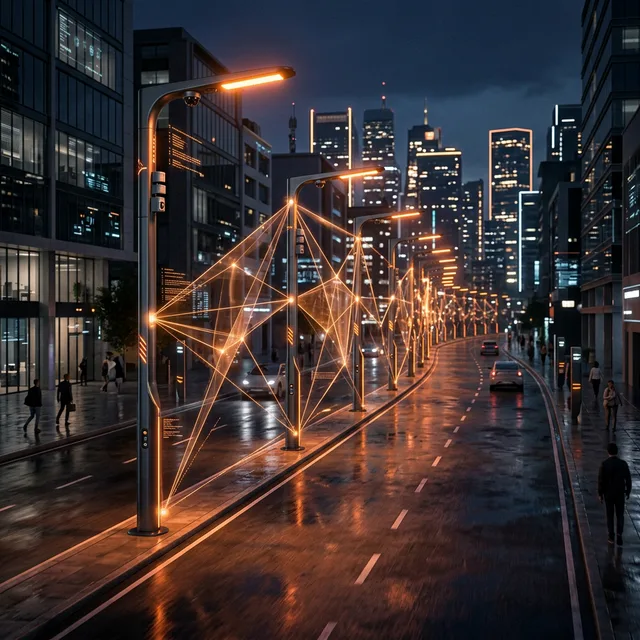
In the LoRa variant, nodes share a network with a LoRa Router as the backhaul. In the NB-IoT variant, each point communicates directly.
When to choose Lux AITHA
Suitable when you need individual control of compatible luminaires, in urban, logistics or large-site environments.
Urban and rural lighting
Streets, parks, squares and municipal access areas.
Logistics areas
Business parks, logistics warehouses and distribution centres.
Sports venues and campuses
Stadiums, fields, hospitals and universities.
Parking and terminals
Car parks, airports and stations.
Preguntas frecuentes
What is the difference between Lux AITHA LoRa and Lux AITHA NB-IoT?
The LoRa variant uses its own 868 MHz LoRa network with a LoRa Router as the network connector. The NB-IoT variant uses the mobile network: each luminaire connects directly, with no intermediate router. The luminaire interface (Zhaga and DALI) is the same.
Is it compatible with the luminaires I already have installed?
Lux AITHA is compatible with luminaires that include a Zhaga Book 18 connector and DALI control.
Do I need my own network infrastructure?
It depends on the variant. Lux AITHA LoRa uses the 868 MHz band and talks to the LoRa Router installed in the cabinet or a nearby point. Lux AITHA NB-IoT needs no own network: it requires compatible NB-IoT coverage and service at the site.
Where is the lighting managed from?
From AITHANEX or from the management system you already use, over MQTT or HTTP.
What happens if a luminaire stops responding?
Lux AITHA generates an automatic alert telling you which point failed, when and what the last recorded state was.
The challenges it solves
Failures invisible until an on-site check
Lux AITHA detects breaks and faults before you find out, with configurable alerts per streetlight.
Uncontrolled consumption due to lack of regulation
Automatically regulate brightness by time of day, traffic density and light conditions to save energy without losing safety.
Manual scheduling across dozens of streetlights
A single application centralizes all schedules and orders, with no need to change configuration at each cabinet.
Stop patrolling to find out which luminaire failed
We analyse your installation, number of points and available connectivity to define the variant and the deployment.